Designing innovative biomaterials and drug-delivery systems through a synthesis-driven, data-focused research approach.
Skills
Analytical Chemistry
Peptide Synthesis & Characterization
Biomaterials & Polymer Science
Material Characterization
Biological Assays
Cell Culture
Assay Validation
Quality Control
Regulatory & Quality
Data Analysis
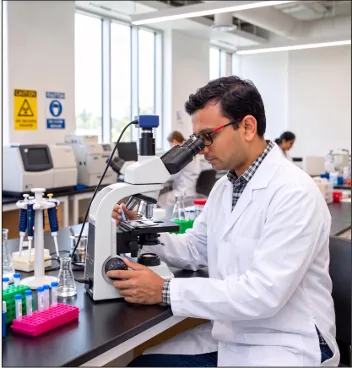
Nauman Nazeer at the microscope

Notable Research Achievement

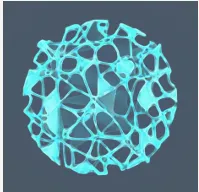
Self-assembling peptide nanostructure

Development of New Biomaterials

Designed and developed a novel self-assembling peptide sequence (mCA4-5) featuring potent antimicrobial and immunomodulatory activities.
Published foundational findings as first author, establishing the peptide's utility for advanced immunotherapy and drug encapsulation applications.
Scaled laboratory adoption of the mCA4-5 sequence, which now serves as a core platform for multiple ongoing team research projects.
Virtual presentation
IUPAC CCCE Virtual 2021

Solving Global Challenges with Chemistry

Symposium (Health) — Therapeutic Interventions to Combat Bacterial Resistance. IUPAC · CCCE Virtual 2021, August 13–20.
Antimicrobial and immunomodulatory activities of self-assembling peptides and peptide nanoparticles
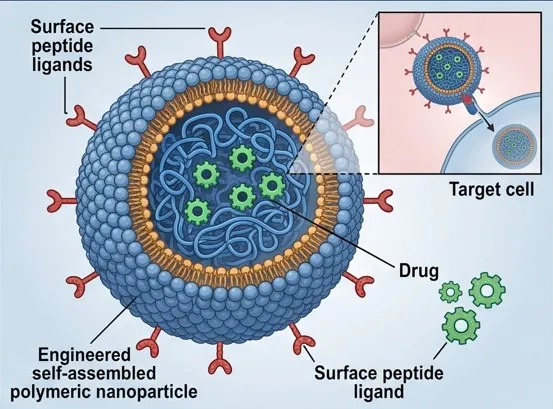
Self-assembled polymeric nanoparticle with surface peptide ligands
Fig. 1 — engineered self-assembled polymeric nanoparticle presenting surface peptide ligands.
01 · Drug delivery

Polymer-based drug delivery systems

Self-assembling polymeric particles that encapsulate a payload and display peptide ligands on the surface, so binding — and therefore uptake — happens at the intended cell. The design question is always the same: how much function can you put on the outside before the assembly stops behaving.
Encapsulation
Release kinetics
DLS
Cell uptake
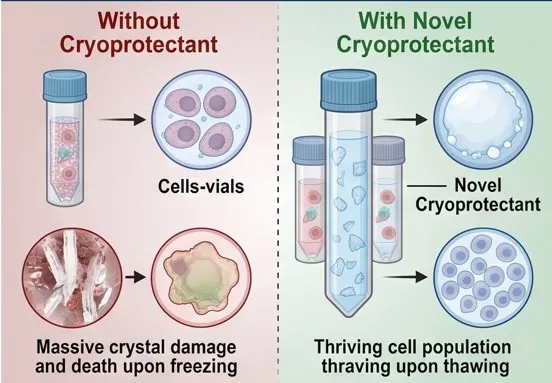
Comparison of cells frozen with and without a novel cryoprotectant
Fig. 2 — without protection, ice destroys the population; with the novel cryoprotectant, cells thrive after thawing.
02 · Cryobiology

Cryopreservation and cryoprotectant development

Formulation and evaluation of cryoprotectants for biological material stability

A postdoctoral project with the Atlantic Veterinary College, the Atlantic Fisheries College and local farming companies: novel cryoprotectants that control ice formation so cells and tissue come back viable after thawing, rather than mechanically destroyed by crystals.
Viability assays
Freeze–thaw protocols
Industry collaboration
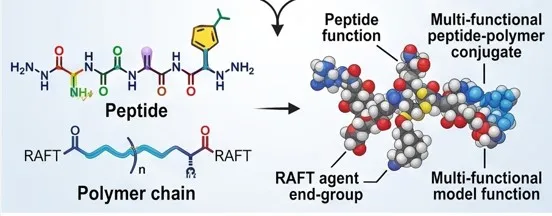
Peptide and polymer chain combining into a multi-functional conjugate
Fig. 3 — peptide + RAFT polymer chain → multi-functional conjugate.
03 · Biomaterials

Peptide–polymer conjugate design

Solid-phase peptide synthesis (SPPS) with controlled polymerisation (RAFT)

The result I'm proudest of: a novel peptide sequence that self-assembles into functional architectures and shows immunomodulatory activity. Conjugated to RAFT-made polymer chains, it becomes a platform — one end doing chemistry, the other doing immunology — with applications in immunotherapy and drug encapsulation.
Peptide design
RAFT
Immunomodulation
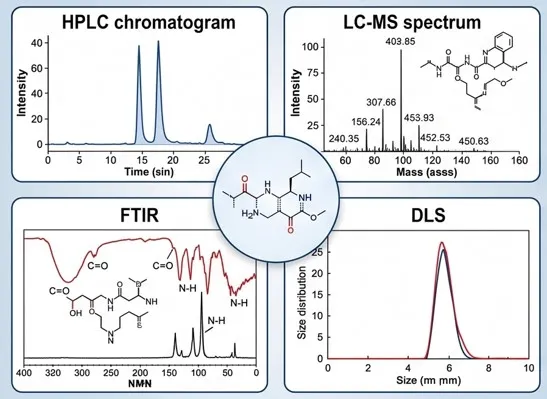
HPLC, LC-MS, FTIR and DLS characterisation panel
Fig. 4 — the standard characterisation panel: HPLC, LC-MS, FTIR, DLS.
Current · Process development

Nanocrystalline cellulose from tunicates

With TUNISTRONG Technologies Inc.: extracting nanocrystalline cellulose and proteins from tunicates for value-added applications, and providing the analytical backbone — method development, characterisation, SOPs and reporting — for process development projects.
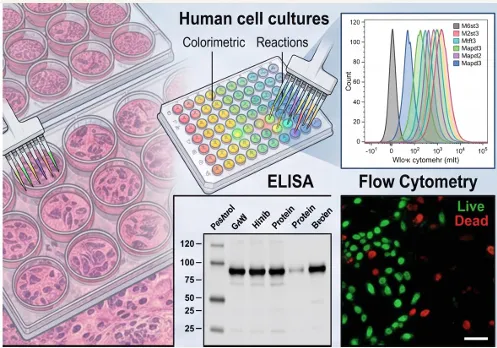
Human cell culture, ELISA, flow cytometry and viability assay panels
Human cell culture
Western blot
Cell viability assay

In Vitro Biological Evaluation & Assay Development

Assessing efficacy, safety and mechanism via ELISA, flow cytometry, Western blot and viability assays in mammalian and bacterial cell-culture systems — designed, validated and documented so the numbers mean the same thing next month.